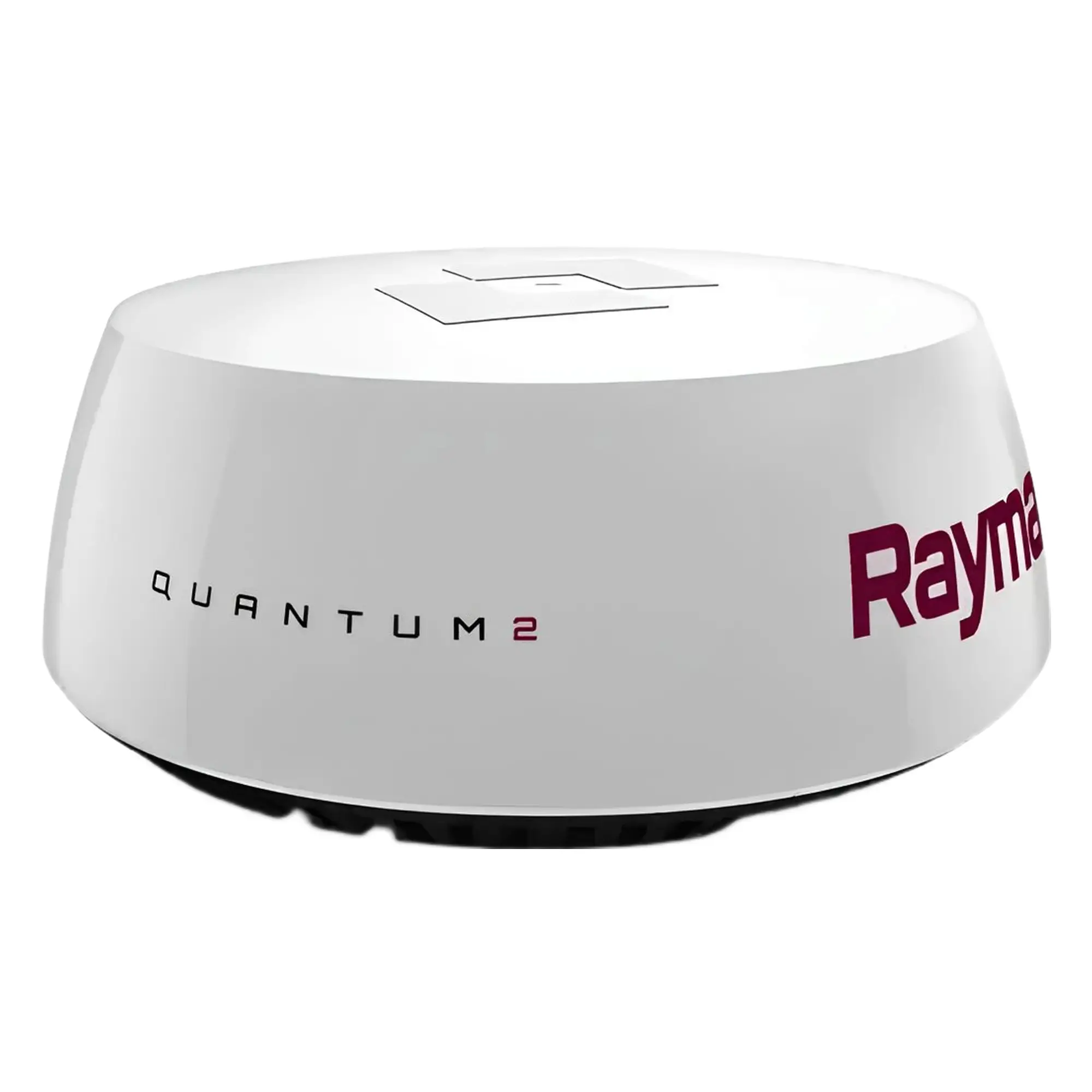
Raymarine – QUANTUM 2 radar
The Raymarine QUANTUM 2 CHIRP Pulse Compression radar with Doppler target detection technology offers you added safety at both long and short ranges.
Thanks to the special processing of Doppler radar data, it is possible to display moving targets in colour on the screen.
Easily identify dangerous targets
Raymarine Quantum 2 Doppler target processing identifies and colour-codes moving radar contacts for instant recognition and reduced collision risk.
Excellent collision avoidance
Quantum 2's MARPA mode provides an effective tool for tracking dangerous targets. Raymarine's MARPA target tracking is the same technology trusted by the United States Coast Guard.
Key features
- Doppler imaging of a moving target allows for excellent situational awareness at a glance
- Fully automatic ARPA target tracking with manual MARPA mode
- The adjustable TrueTrails target history shows the movement history of moving contacts.
- CHIRP pulse compression detects contacts up to 5.5 metres away to enable navigation in zero visibility.
- 24-mile range for early detection of traffic, navigation aids, landing, and weather
- Instant awareness – Quantum boots up and is ready to use in seconds
- Excellent interference rejection eliminates noise from other radars
- Simplified installation via Wi-Fi or thin-wire network connection
- Easy to upgrade – the Quantum 2 fits the same bolt pattern as other Raymarine scanners
- Lightweight and easy to install – the Quantum weighs up to 50% less than comparable magnetron radars
- Low emissions – install Quantum anywhere on board
- Low energy consumption extends battery life while sailing
Kuidas Doppleri radar töötab?
Microwave energy waves are reflected back from a distant target, just like with a normal radar.
Moving targets return echoes whose frequencies are shifted up or down from the originally transmitted frequency.
For incoming targets, the frequency increases as the leading edge of returning echoes is received more frequently as the target's range decreases.
When targets are moving away, the frequency drops as the returning echoes propagate with increasing range.
Doppler radars are designed to detect these small frequency shifts and use them to classify moving radar targets. A Doppler radar is specifically tuned to detect the frequency shift of radar echoes returned by moving and stationary targets.
The Quantum 2 then uniquely encodes moving targets by colour to indicate whether they are approaching or moving away. Incoming targets are red.
Outgoing targets are green. Colour-coded targets distinguish moving traffic from other stationary targets, such as land, navigational aids or stopped/anchored vessels.
Fully automatic target detection and tracking
The Quantum 2 radar offers fully automatic target detection and tracking. You can set up custom safety or exclusion zones and receive notifications of new radar contacts entering the zone. Quantum 2 will automatically start tracking these contacts, calculating their course, speed, closest point of approach, and more. Dangerous contacts will be alerted to you with audible alarms and easy-to-understand on-screen graphics.
The Quantum 2-l is Raymarine's new True Trails target history display. The True Trails function allows you to see the historical „trail“ behind every moving contact. This additional information makes it even easier to interpret the movements of other vessels and make smart manoeuvring decisions for safe overtaking.
Like all Raymarine Quantum systems, this one has a rugged and lightweight design that is extremely simple to install. The Quantum 2's power consumption is very low, making it particularly well-suited for boats that operate solely on battery power. With Doppler, the Quantum 2 can be installed as a traditional wired configuration or use its built-in WiFi technology to connect to your Raymarine MFD.
| General Specifications |
| Dimensions: diameter x height |
541.0 mm × 209.5 mm |
| Cal |
5.6 kg |
| Supply voltage |
Is the nominal voltage 12V or 24V DC
Minimum: 10.8 V DC | Maximum: 31.2 V DC |
| Energy requirement |
Transmission mode (maximum): 17W | Standby mode: 7W | Sleep mode (only applies to radars connected via WiFi): 2W |
| Water resistance: |
IPX6 |
| Operating temperature range: |
-10°C to +55°C |
| Storage temperature range: |
-25°C to +70°C |
| Additional storage conditions: |
Keep upright; do not block the ventilation openings on the underside |
| Moisture |
Up to 95% at a temperature of 35°C |
| Maximum wind speed: |
100 knots |
| Sender |
| Type: |
X-ray pulse compression transmitter |
| Transmission frequency |
9354 MHz to 9446 MHz |
| Horspower |
20 W |
| Duplexer |
Circulator |
| Impulse Widths (3 dB) |
Between 4 ns and 14.7 |
| Chirp-ribalaius: |
Pulse length: 40 ns to |
| pulse repetition frequency |
2083 Hz |
| Chirp-ribalaius: |
Up to 32 MHz |
| Offline mode |
Scanner rotation – OFF | Scanner transmission – OFF | WiFi connection – ON |
| Aerial |
| Type: |
Patch mass |
| Effective width (nominal) |
Horizontal: 4.9° | Vertical: 20° |
| Polarisation |
Horizontal |
| Rotational speed |
24 min/rev |
| Doppler |
| Track freight |
10 simultaneous MARPA and/or ARPA target tracking (with Doppler-enabled ARPA) |
| Target filtering: |
The True Motion mode only detects objects moving relative to the base. |
Guides
Download Quantum Doppler radar Installation guide
See what it should be like Quantum radar Plotter minimal software version



 Eesti
Eesti  English (UK)
 Suomi
Suomi
 Русский